The fuss
On 22 September, Eli Lilly launched LillyDirect Australia. It is a website where people with a prescription for Mounjaro, Lilly’s injection for weight management, type 2 diabetes and obstructive sleep apnoea, can order it and have it delivered. The Australian had broken the story the day before, and the framing stuck. By the time the ABC covered it, the move was a bid “to bypass bricks-and-mortar pharmacies” that had been “broadly condemned by doctors and pharmacists”.
The RACGP called it a “fragmented free-for-all”. Within a week, the two biggest pharmacy bodies had found a stronger word. The Pharmacy Guild and the Pharmaceutical Society of Australia warned jointly that it “sets a dangerous precedent that risks the Americanisation of Australia’s healthcare system”.
“Americanisation” is a strong word, and a useful one, because it can be tested. Lilly runs a LillyDirect in the United States and another in the United Kingdom. So the question isn’t whether LillyDirect is a good idea. It’s narrower and more answerable: is the Australian version the American one?
Same name, three countries
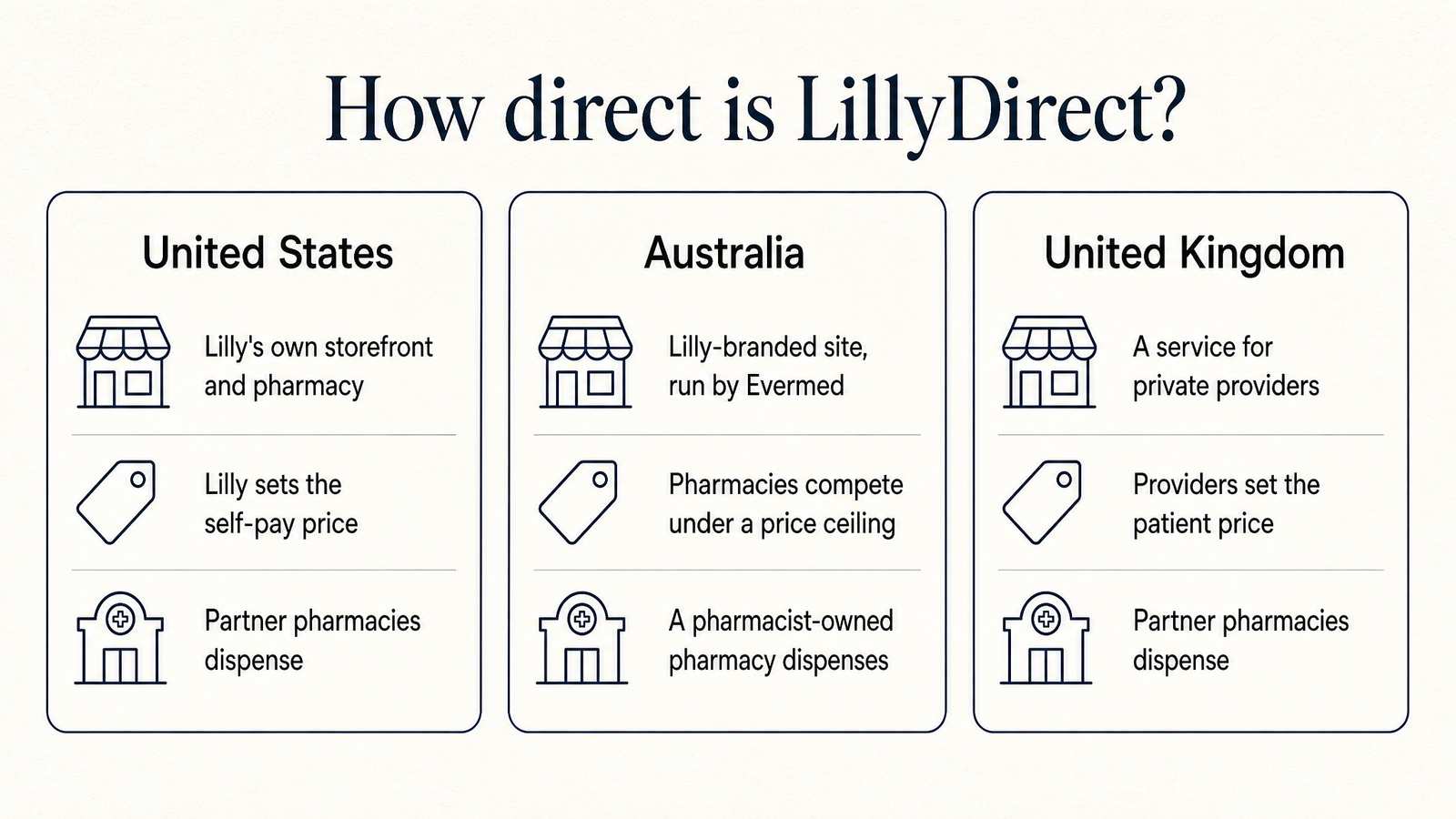
In the United States, LillyDirect is as direct as the name suggests, and it has become more so every year. Lilly runs the storefront and publishes its own self-pay prices. Since mid-2025, a Lilly subsidiary, LillyDirect Pharmacy LLC, has been registered as a pharmacy that receives the prescriptions. Partner pharmacies (Amazon Pharmacy, Gifthealth, Fuze Health and Walmart) dispense, pack and ship, or hand over at the counter. When Lilly launched cheaper self-pay vials of Zepbound (the US weight-loss brand of the same molecule) in August 2024, it sent them through a new self-pay pharmacy channel and said the channel works by “removing third-party supply chain entities”. Lilly also uses price to shape behaviour. For the 7.5 mg to 15 mg single-patient-use Zepbound KwikPen, its self-pay offer is US$449 on the first purchase and on each refill made within 45 days, and US$499 to US$699 otherwise.
Lilly’s chief executive, David Ricks, has been careful about what this is for. In February 2024, as reported by BioSpace, he said: “We haven’t thought about it as a way to create some new retail distribution business. It’s a way to serve the patients that want our medicines better.” In October 2024 an analyst on Lilly’s earnings call asked whether the vial launch had changed US distributors’ appetite to stock Lilly’s pens, or Lilly’s terms with them. The company’s answer was “no and no. We didn’t change our terms”. Both remarks are about the US, and both are from 2024.
In the United Kingdom, LillyDirect is almost the opposite. Launched in June 2026, it is a “post-prescription dispensing and delivery service” offered to private UK healthcare companies. Partner pharmacies (Pharmacy2U and Onescript) dispense. Lilly sets what pharmacies pay for the medicine, but private providers set their own patient prices: when Lilly raised its UK list price in 2025, the country’s biggest online pharmacy froze what it charged patients. Lilly says it plays “no role in any clinical decisions”.
Australia sits in between on who faces the patient and who sets the price. On dispensing, it looks much like the UK. Lilly supplies the brand and the public information, while Evermed, an Australian digital health company, operates the ordering platform. The price works differently from the US. “When you order, you’re shown the most you’ll pay,” Lilly’s page explains, with delivery included. Partner pharmacies compete on price beneath that ceiling, and if the dispensing pharmacy’s price is lower, the patient gets a small refund. Nor can Lilly own the pharmacy. With limited exceptions, every state and territory restricts pharmacy ownership to pharmacists, and in New South Wales, for example, the law authorises the supply of prescription-only medicines such as Mounjaro when it is “by a pharmacist in a pharmacy” and on a valid prescription. Lilly’s own page is blunt about it: “LillyDirect is not a pharmacy and does not prescribe or dispense medication.”
Follow your order
Here is what happens when someone orders.
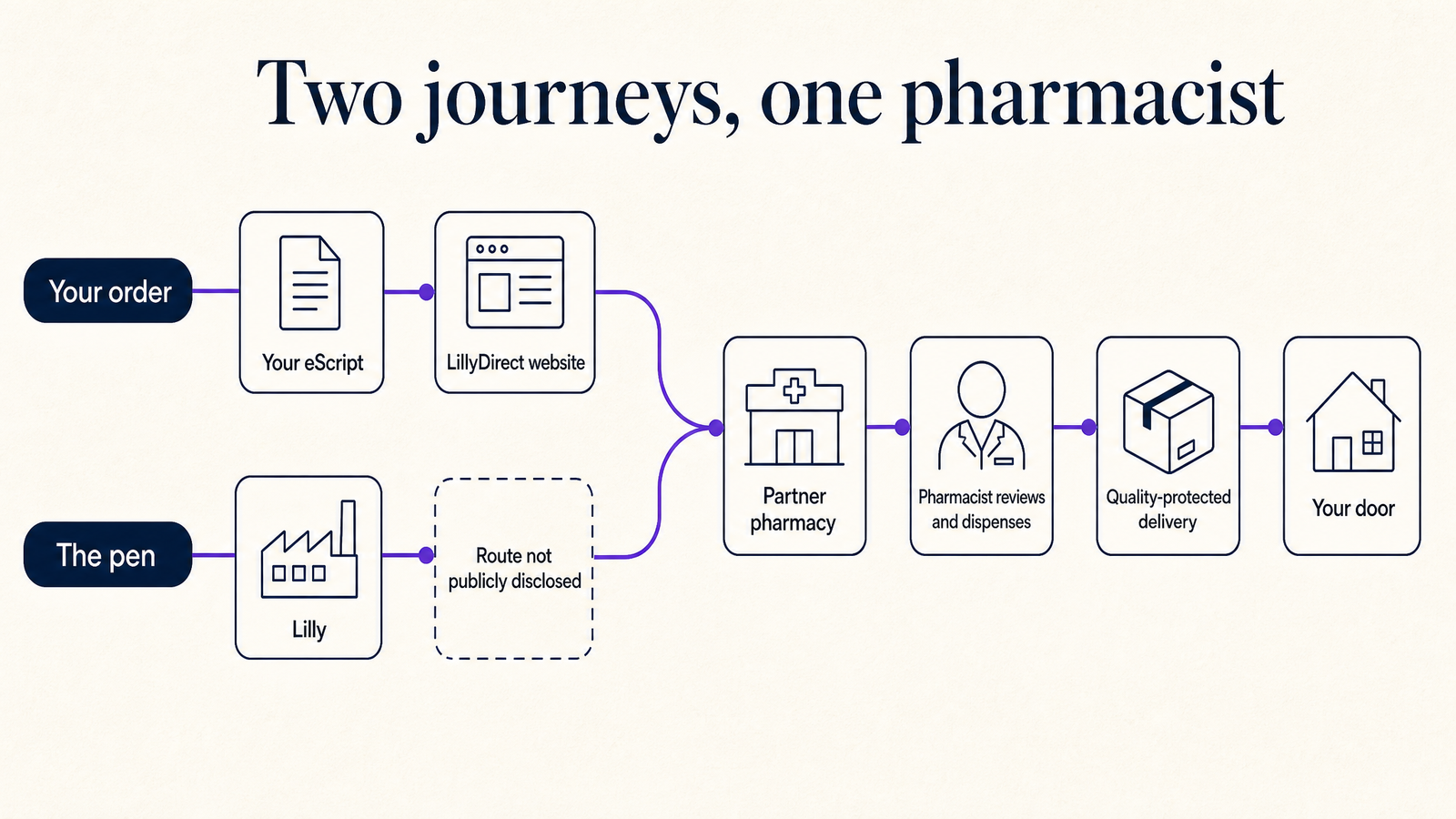
They start with an eScript, from their own doctor or from an independent telehealth doctor, including the ones Lilly lists on its website. LillyDirect itself does not prescribe. They enter the script’s token on a Lilly-branded site that Evermed operates. Evermed’s public configuration lists “Lilly Direct” as one of about 30 partners on the platform, alongside telehealth brands that use the same plumbing. The price appears only after the script has been added.
The platform then sends the order to a partner pharmacy. The patient doesn’t choose it. Evermed’s pharmacy terms allow a customer to request a specific pharmacy, but the LillyDirect flow doesn’t offer the option. The partner pharmacies aren’t publicly named, though each patient is given the dispensing pharmacy’s contact details with their order.
At that pharmacy, a registered pharmacist reviews the script, and Evermed’s pharmacy terms let the pharmacy reject an order. One patient reported publicly that an order was cancelled over a dose question, then dispensed after a re-order and a call from the pharmacist. The pen then goes to the door in what Lilly calls a “quality-protected package”, usually within one to two business days. The account, order tracking and repeats sit with the platform, under Lilly’s brand.
So the order has a new road, and Lilly’s name is on the entrance.
Follow the pen
The pen’s road is where the “bypass” story gets interesting, and where most of the commentary has run ahead of the facts.
Start with what is on the public record. Evermed’s consumer terms say orders are dispensed and supplied by registered community pharmacies, which sell the medication. Its pharmacy terms provide for title to pass to the customer on full payment. Neither discloses how the pharmacy obtains its stock.
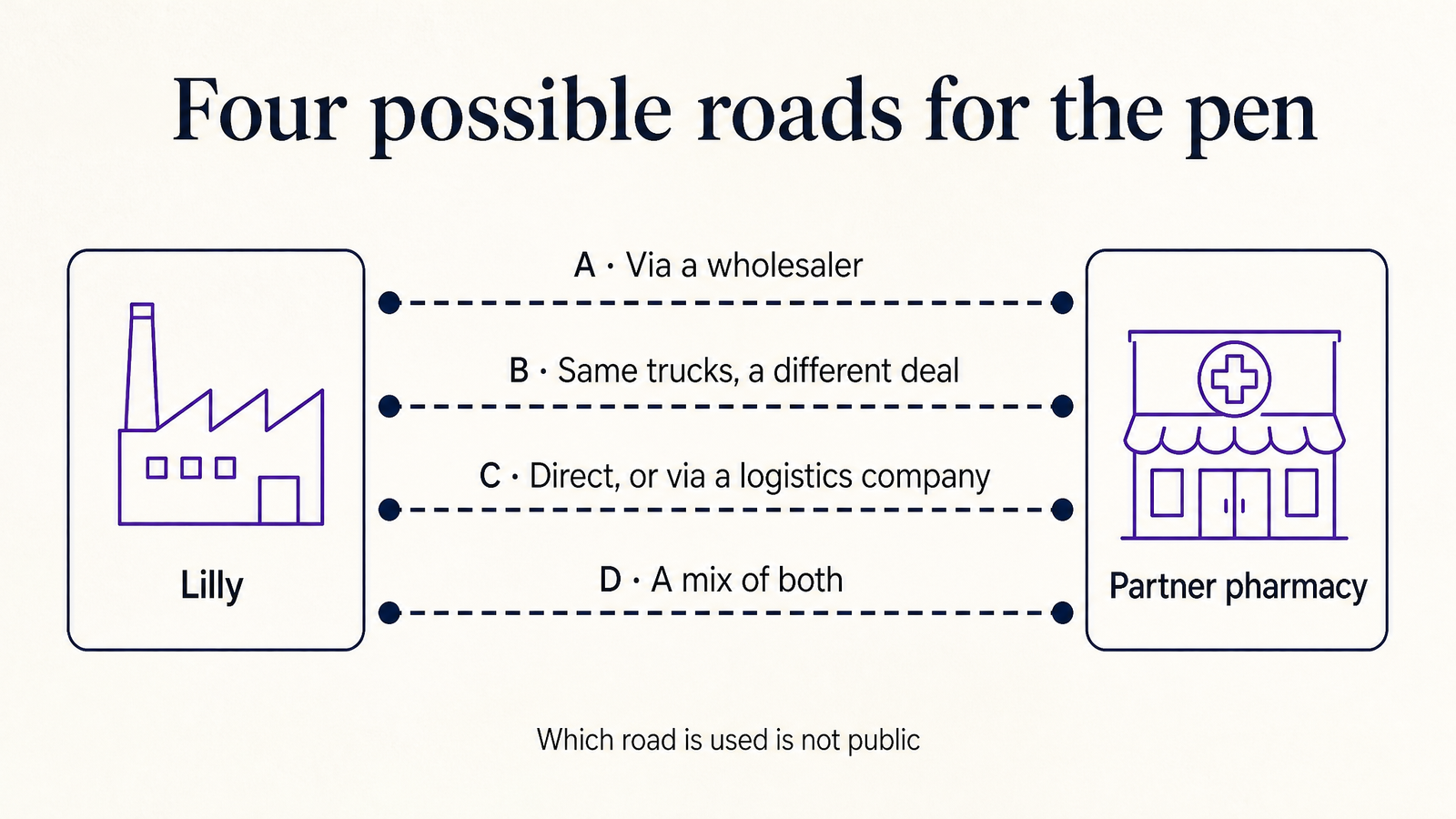
How the partner pharmacies get that stock has not been publicly disclosed. There are four broad roads a pen could take:
- A. Lilly to a wholesaler to the pharmacy, as before.
- B. The same trucks, with a different commercial deal behind them.
- C. Lilly, or a logistics company working for it, direct to the pharmacy.
- D. A mix: the usual wholesale route for most pharmacies, and a direct route for a few high-volume ones.
None of these would be new. Australia’s wholesaling code recognises manufacturers and third-party logistics providers, as well as wholesalers, as links in the chain, subject to state licensing. Mounjaro is not on the PBS, so the wholesalers’ obligation to supply every PBS medicine to every pharmacy doesn’t apply to it. Australia has also seen road C before. Pfizer went direct to pharmacies through DHL in 2011, and AstraZeneca did the same for a set of high-value medicines in 2017. AstraZeneca returned to the wholesalers in 2019, citing feedback from community pharmacists. Pfizer followed in 2021, saying it wanted to focus on its core business. Mixed arrangements exist today too. Novo Nordisk, Lilly’s main competitor, tells pharmacies to order some of its products, such as growth hormone, directly through its logistics provider.
In the US, Lilly built a second road for the boxes. In Australia, the public can see the second road for the orders. Where the boxes travel isn’t public.
The money
LillyDirect doesn’t publish a price list. Lilly’s page says pricing is shown on the platform only after a patient adds their eScript, and that delivery is included in the price. Each four-dose pen is priced by strength.
The price shown is a ceiling: “Pharmacies taking part in LillyDirect compete on price, so what you actually pay depends on the pharmacy that fills your order.” If that pharmacy’s price is lower, the patient gets a small refund. The ABC reported that competition law stops Lilly from saying how much cheaper the platform is than buying elsewhere.
What is new is a ceiling price for each pen, set out on one platform for anyone with a script, with pharmacies competing beneath it.
The arguments
Against LillyDirect, the case is about continuity of care, not price. The RACGP’s president, Dr Michael Wright, told the ABC that the model means medicines may be “delivered by someone who doesn’t actually have full access to your whole record”, which “really creates risks for patients”. He pointed to people with eating disorders getting these drugs away from their usual GP and pharmacist. The Guild and PSA called it “a clinically inferior model of care”. The Guild’s president, Professor Trent Twomey, said: “Medicines aren’t ordinary consumer products and pharmacists aren’t simply fulfilment centres.” Professor Barbara Mintzes of the University of Sydney put the commercial concern most plainly: “Lilly has an interest in keeping people on the medicine that is being prescribed.”
Against the critics, the case is that none of this is new. The AMA’s president, Dr Danielle McMullen, told Pharmacy Daily that cheaper medicines are welcome but can’t come at the expense of quality and safety. She also noted that “platforms already exist that allow patients to load scripts and have them delivered”. In a public LinkedIn post, one pharmacist argued the profession was being inconsistent: opposing LillyDirect for fragmenting care while also pushing for wider prescribing powers that would move patients away from their GP. On a junior doctors’ forum, the Guild’s position was read the same way. And one patient wrote publicly that the only thing the bricks-and-mortar pharmacist who sold them their first pen asked was whether they needed needles.
In the public threads we reviewed, several comments were unimpressed rather than alarmed. The most common complaint was that the discount was too small to bother with. There are practical worries about couriers, refrigeration in 40-degree heat and regional delivery. Some people disliked handing their details to a platform carrying the manufacturer’s name. Lilly’s page says Evermed doesn’t share information that identifies patients with Lilly, except where the law requires it, such as safety reporting. And there’s a quieter fear: that LillyDirect could one day bring in US-style rules that tie the price to reordering regularly. As at 21 October, no such rule applies in Australia.
Lilly’s answer has been the same throughout: “Australian doctors prescribe the medicine, Australian pharmacists review and dispense prescriptions, and Australian healthcare, pharmacy, privacy and regulatory requirements apply at every stage,” a spokesperson told the ABC. “The LillyDirect platform does not circumvent the role of pharmacists.” Its Australian page says the service “operates entirely within the Australian healthcare system, with all treatment decisions remaining between patients and their healthcare professionals”. And Lilly’s Australian general manager, Manny Simons, told newsGP that “LillyDirect complements the care provided by GPs and other healthcare professionals”, adding that GPs had “repeatedly” told Lilly they wanted more affordable access to its medicines.
So: Americanisation?
Less than the headlines suggest, and not quite where the critics are pointing.
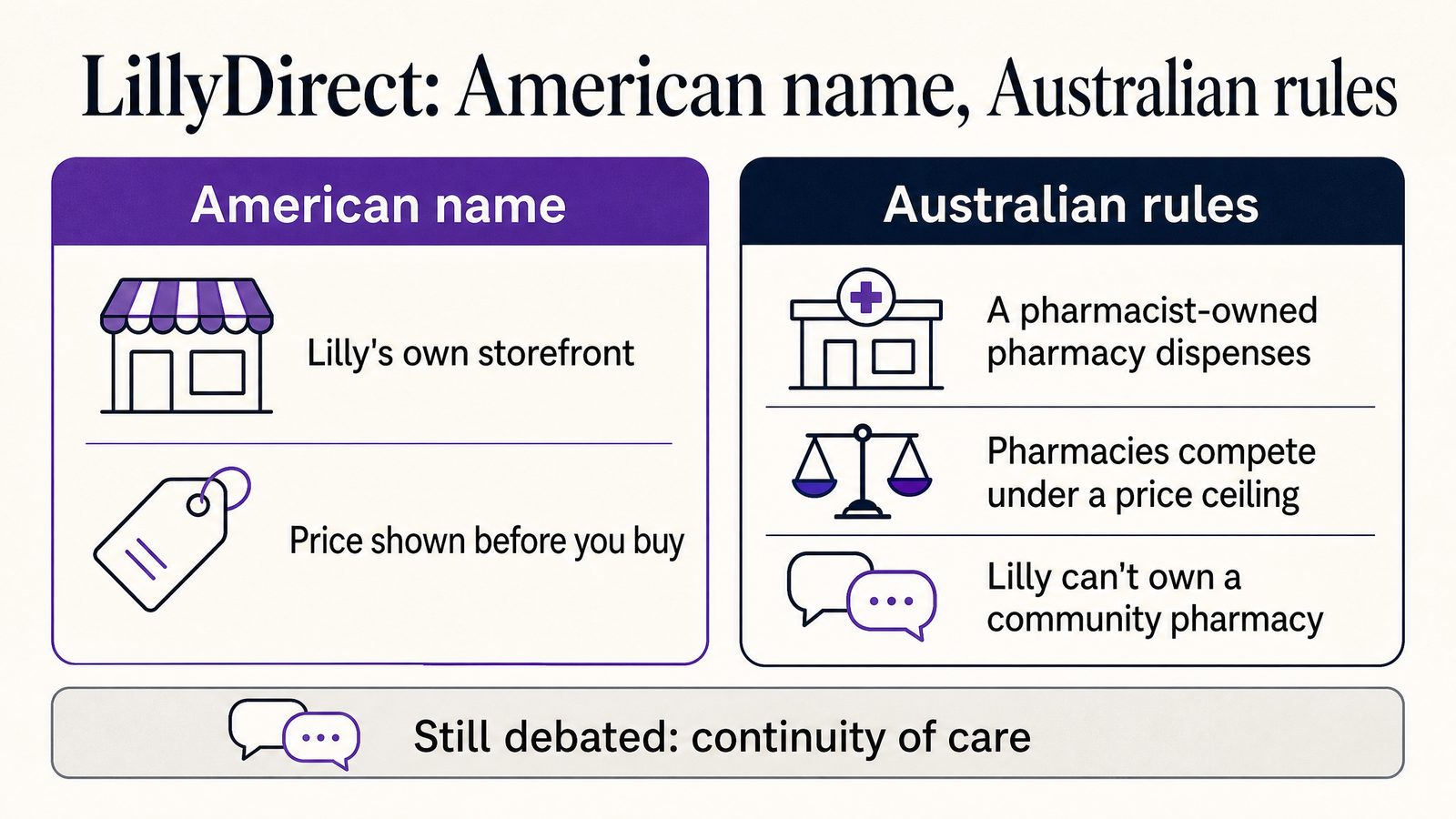
Some of it is American. A manufacturer’s own storefront, showing patients a price for each pen before they buy, is how LillyDirect began in the US, and we know of no earlier example in Australian community pharmacy. Unlike the US, though, the Australian price is a ceiling, and the pharmacies behind it still compete on price.
Some of it isn’t. In Australia, a pharmacist-owned pharmacy still dispenses every pen, a pharmacist can still refuse, and no insurer or pharmacy-benefit manager sits in the middle. Lilly can’t own a community pharmacy here. Those Australian dispensing safeguards remain in place. That does not, by itself, settle concerns about commercial influence or continuity of care.
And some of the American influence arrived by a different door. In June 2026, the US telehealth company Hims & Hers completed its takeover of Eucalyptus, the Australian company behind the weight-loss telehealth brand Juniper. At the end of August, three weeks before LillyDirect, its men’s brand Pilot relaunched as Hims. Juniper is one of two independent telehealth clinics, alongside Mosh, that Lilly lists on its own Australian obesity care page.
Behind all of it sits the PBS. In March 2026 the government’s advisory committee recommended Mounjaro for some people with type 2 diabetes. In April, Lilly declined the price terms as “unrealistic and unviable”, ending its fourth attempt at listing. At launch, Simons told newsGP that LillyDirect forms part of Lilly’s response “while we continue to advocate for broad reimbursement via other pathways”. Trade press reported him describing it as a direct response to the growing challenges of securing government funding for new medicines. Mounjaro remains private, and we found no public statement from the federal government on LillyDirect.
What isn’t public
Some of the facts that matter most haven’t been disclosed:
- which pharmacies dispense LillyDirect orders;
- how pharmacies’ prices are set beneath the ceiling shown, and who bears any difference;
- how partner pharmacies obtain their stock;
- whether patients who use LillyDirect fare any differently, for better or worse, from those who don’t: no data has been published either way;
- when the promised click-and-collect option and other Lilly medicines will arrive.
Until they are, anyone claiming to know where this ends is guessing.
Sources
Companies, regulators and legislation
- Lilly Australia, LillyDirect (accessed 21 October 2026)
- Lilly Australia, Independent telehealth for obesity (accessed 20 October 2026)
- Eli Lilly and Company, Lilly releases Zepbound single-dose vials, 27 August 2024
- Lilly USA, Zepbound KwikPen Self-Pay Savings Card terms and conditions (accessed 21 October 2026)
- NPPES NPI Registry, LillyDirect Pharmacy, LLC (enumerated 24 July 2025)
- Evermed, Terms and conditions (accessed 21 October 2026)
- Evermed, Pharmacy terms and conditions (accessed 21 October 2026)
- Pharmacy Guild of Australia and PSA, Guild and PSA warn against Americanisation of medicine supply, 28 September 2026
- NSW Medicines, Poisons and Therapeutic Goods Act 2022, section 30
- Queensland Parliament, Pharmacy Business Ownership Bill 2023, explanatory notes
- TGA, Australian code of good wholesaling practice for medicines in Schedules 2, 3, 4 and 8
- Pfizer Australia, Pfizer Australia transitions to wholesaler distribution model, 19 May 2021
- Novo Nordisk Australia, Frequently asked questions for healthcare professionals
- Hims & Hers, Hims & Hers completes acquisition of Eucalyptus, 2 June 2026
- Hims & Hers, Hims arrives in Australia, 31 August 2026
- Eli Lilly Q3 2024 earnings call transcript (The Motley Fool), 30 October 2024
Reporting
- The Australian, 21 September 2026 (paywalled)
- RACGP newsGP, Eli Lilly launches Mounjaro home delivery service, 22 September 2026
- Pharmacy Daily, Lilly launches new GLP-1 access platform, 22 September 2026
- Pharmacy Daily, Guild, PSA slam Lilly model, 28 September 2026
- ABC News, Doctors condemn Eli Lilly move to dispense GLP-1 medication Mounjaro direct to door, 30 September 2026
- Pharmaphorum, Lilly launches LillyDirect in the UK, 25 June 2026
- The Pharmacist, Lilly launches home delivery service for privately prescribed medicines, 29 June 2026
- The Pharmaceutical Journal, UK's biggest online pharmacy freezes Mounjaro price, 18 August 2025
- BioSpace, Lilly, Pfizer take meds straight to consumers in renewed DTC push, 4 September 2024
- Pharmacy Daily, AstraZeneca drops direct distribution, September 2019